Year 7 · ages 11 to 12 · all subjects

Year 7 practice at home

Year 7 practice at home starts with knowing what your child learns this year. For most children it is the first year of secondary school. Maths moves on to ratio, percentages and negative numbers. Below you see it subject by subject.

Every subject has a free first lesson. Pick one and start today.

Age
11 to 12 years
Subjects
Nine subjects in one place
Try it
A free first lesson in every subject
01

What's new in Year 7?

Year 7 is the first year of key stage 3.

A new school, new teachers and a new timetable take some getting used to. In maths, ratio and percentages show up in everyday problems. Negative numbers, coordinates and probability are new too. In English, your child writes longer arguments with however and therefore. Reading asks for evidence and opinions. A short daily habit gives your child a steady base.

02

What does your child learn in Year 7?

Maths

  • Ratio, and working out the price of one
  • Percentages, including increases and decreases
  • Negative numbers, from adding to dividing
  • Coordinates in all four quadrants, and reading graphs
  • Probability with coins, dice and experiments
  • Squares, cubes and powers of 10
  • Order of operations, with brackets first

Grammar and punctuation

  • Putting words in the right order
  • The past simple and the past continuous
  • The present perfect, like I have finished
  • Choosing between will and going to
  • Questions and negatives with do and does
  • Giving advice with should
03

How to help at home, ten minutes a day

10 min
  1. 1

    Help your child plan the week. A short daily slot works better than a long one.

  2. 2

    Use real life for maths, like prices, discounts and recipes.

  3. 3

    Let your child explain how they worked it out. You will see where they get stuck.

04

How does your child practise Year 7 in BrainBite?

Each lesson takes a few minutes. A mentor explains every step at your child's pace. The explanation adapts to your child. As a parent, you see what goes well and what needs more practice.

05

Free worksheets for Year 7

Print a worksheet and practise together on paper. Each one has an answer sheet.

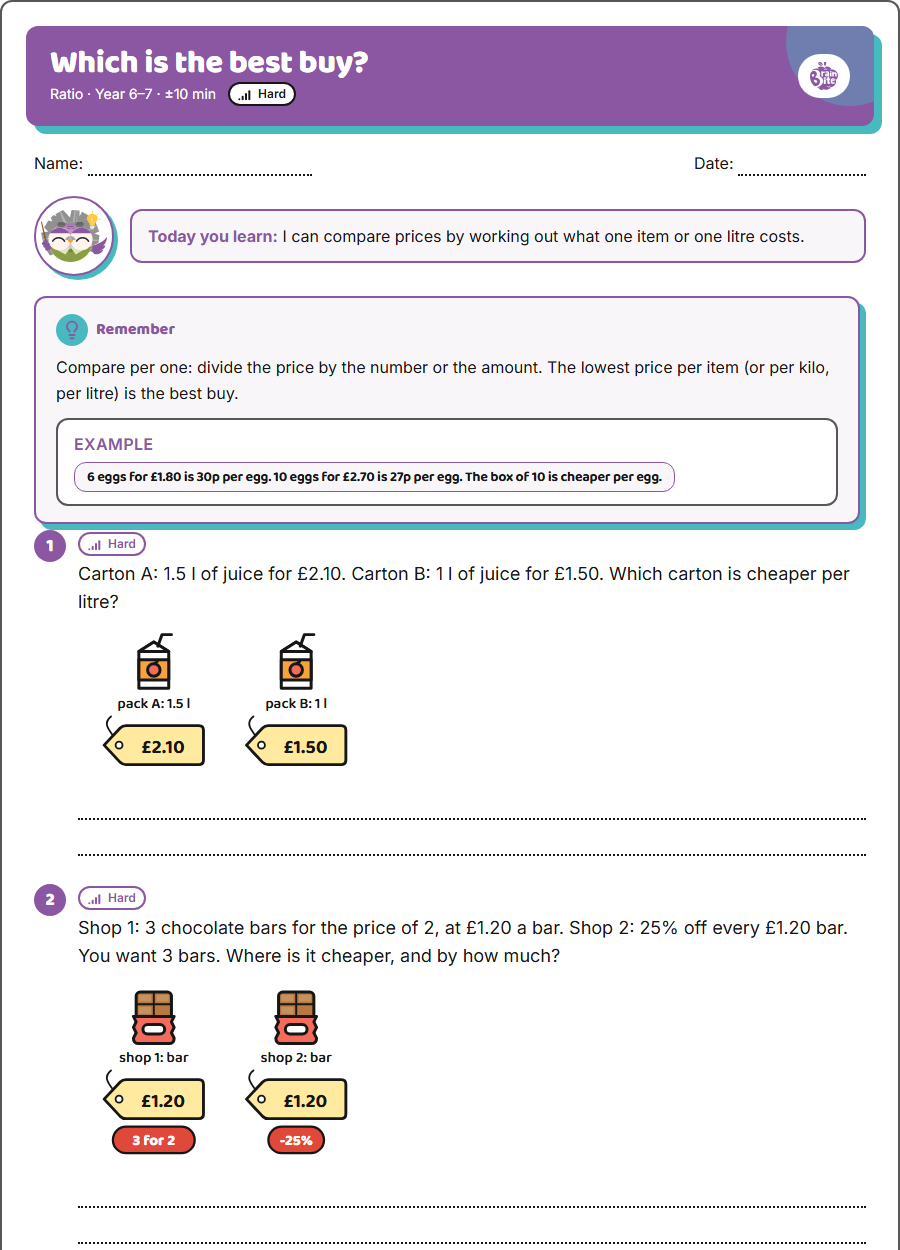
  • Preview of the worksheet Which is the best buy?
    MathsYears 6 and 7Questions

    Which is the best buy?

    You compare prices by working out what one item costs.

    Download the worksheet

    PDF, with an answer sheet for you.

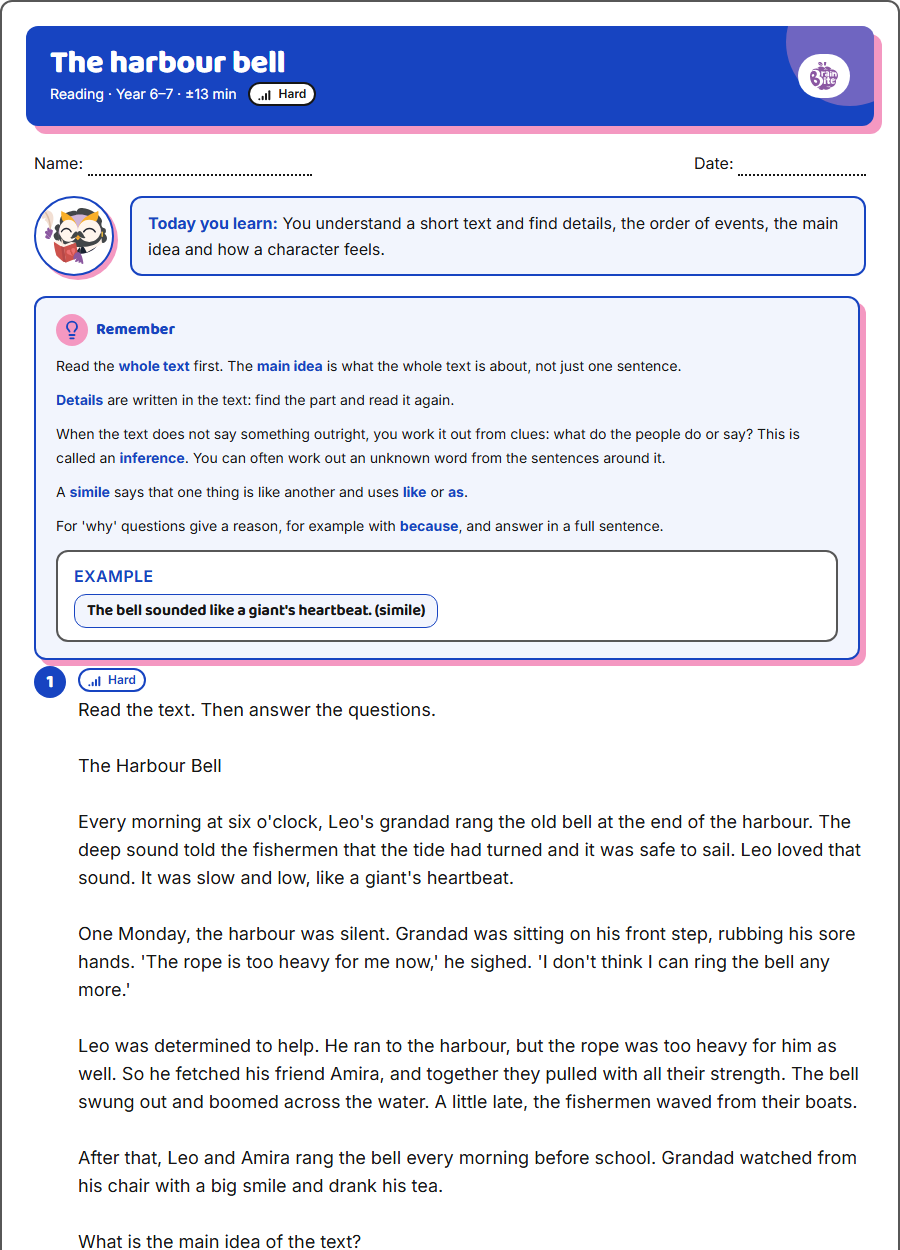
  • Preview of the worksheet The harbour bell
    EnglishYears 6 and 7Story with questions

    The harbour bell

    You read a short text and find details, the main idea and feelings.

    Download the worksheet

    PDF, with an answer sheet for you.

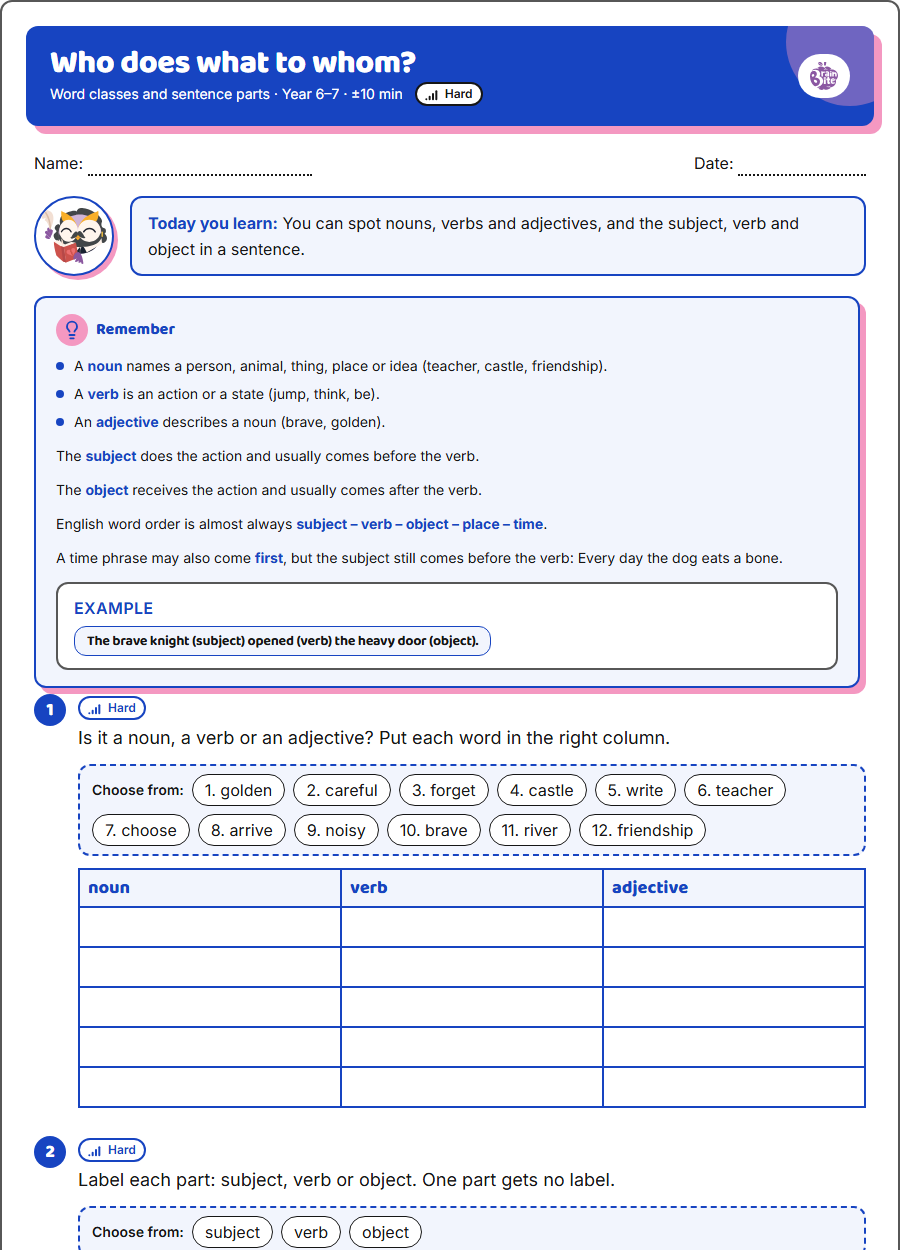
  • Preview of the worksheet Who does what to whom?
    EnglishYears 6 and 7Sentence parts

    Who does what to whom?

    You spot nouns, verbs and adjectives, and the subject and object.

    Download the worksheet

    PDF, with an answer sheet for you.

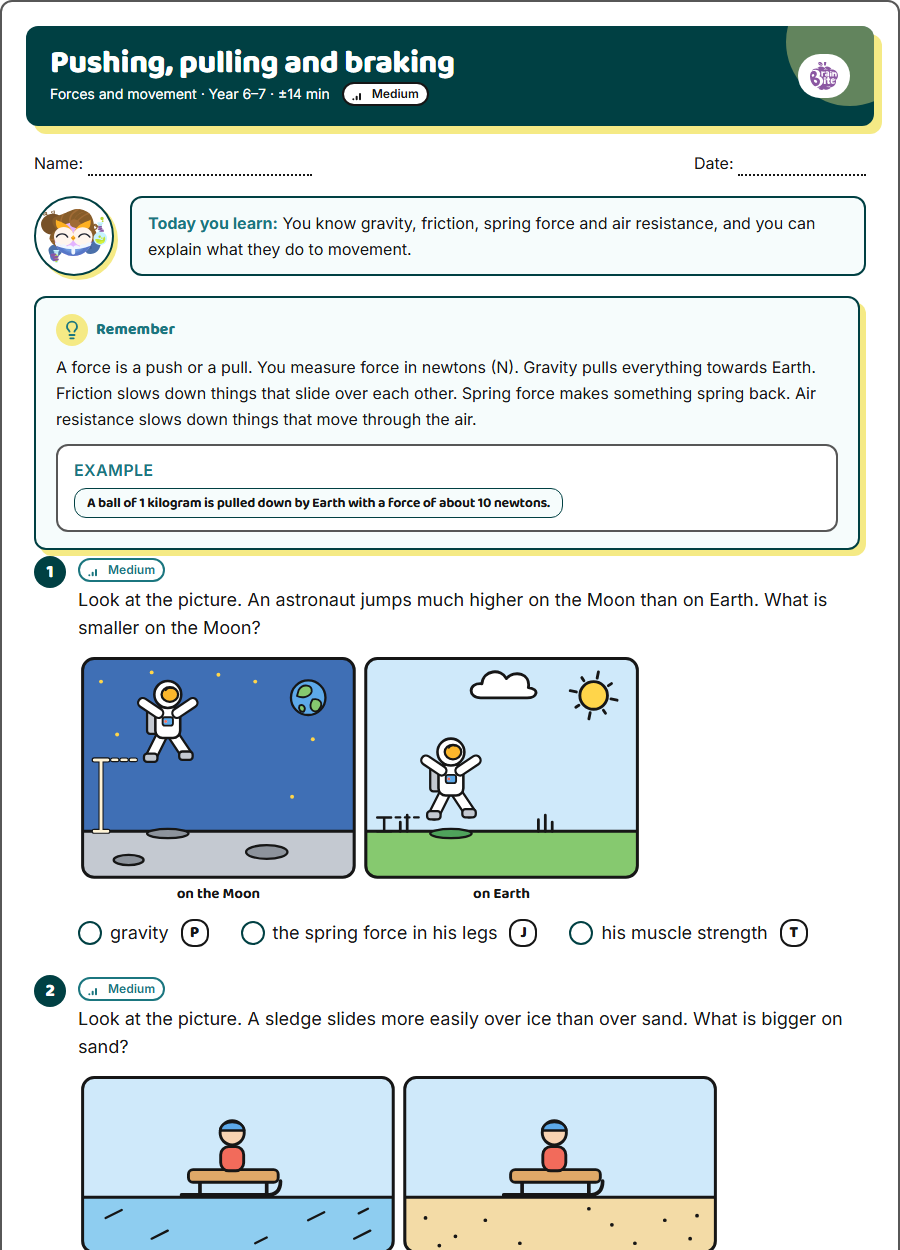
  • Preview of the worksheet Pushing, pulling and braking
    ScienceYears 6 and 7Secret word

    Pushing, pulling and braking

    You know gravity, friction, spring force and air resistance.

    Download the worksheet

    PDF, with an answer sheet for you.

06

Which tests does your child take in Year 7?

There are no national tests in Year 7 in England. Your child's new school checks progress in its own way. Ask the school how your child is settling in.

07

What comes in Year 8?

In Year 8 your child starts algebra, with letters for unknown numbers. Equations and formulas follow. In English, writing turns to arguments for and against. A firm grip on negative numbers and ratio makes algebra easier.

08

Questions from parents

In maths, ratio, percentages, negative numbers and probability. In English, more tenses and linking words like however. And in science, cells, forces and electricity.

Every subject has a free first lesson. Pick one and start today.