Watch a parent read with a young child and it looks like one thing. It is actually three jobs, done so smoothly they blur together. The adult talks with the child about the story. The adult listens while the child reads aloud and catches the stumbles. And before any of that, someone picked a book that was hard enough to stretch this child and easy enough not to defeat them. Every AI reading product is a bet on at least one of those jobs. The evidence on each is very different.
Job one: talking about the story
Four decades of research on what is called dialogic reading show that children's language and comprehension grow when an adult asks questions during reading. Why do you think the bear is hiding? What would you do? The child does most of the talking, the adult steers. The problem has always been the adult. Plenty of parents and teachers never learn the technique, and the children with the least access to it fall behind first. A trial in Beijing with 148 kindergartners from less-resourced families tested whether a machine could carry that conversation. Children shared a picture book with either a chatbot or a trained adult, who either asked dialogic questions or simply read the story. The questioning drove the gains, and it worked just as well coming from the chatbot as from the human. The chatbot that only narrated produced the lowest comprehension of all four groups. The technology without the technique did nothing. The technique delivered by technology worked.
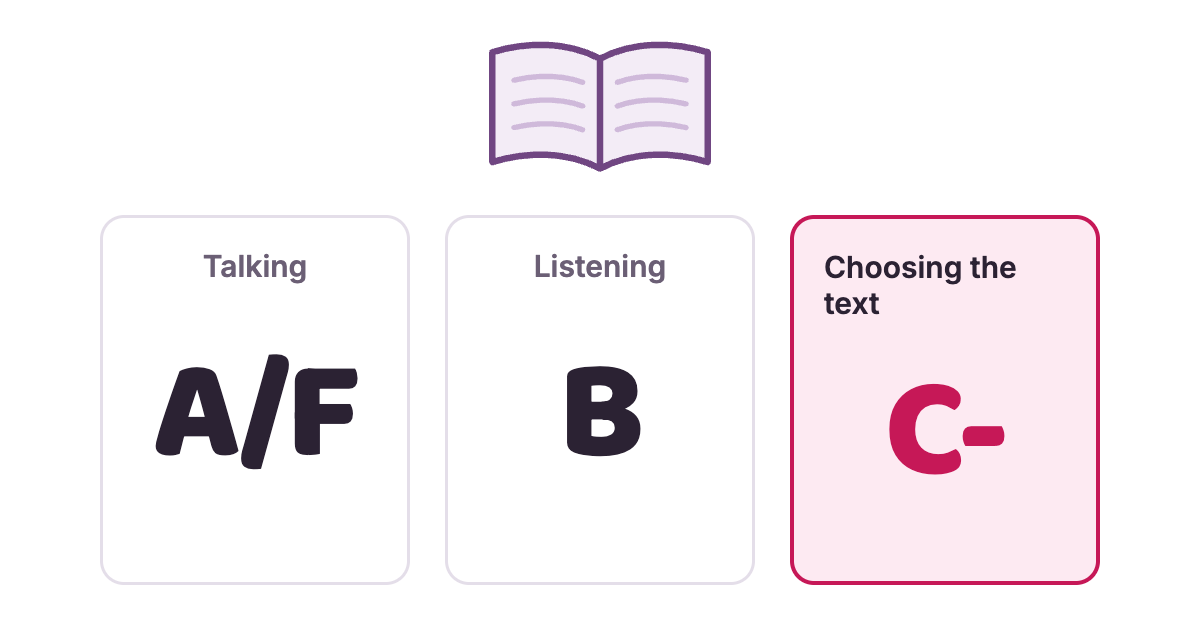
Reading instruction is three jobs: talking about the text, listening to the child read, and choosing the right text.
The same job, done backwards
There is a second kind of AI reading companion that looks identical from across the room: a student and a chatbot, talking about a text. But the conversation runs the other way. The student asks, the machine answers. In a trial with 344 English teenagers, students who studied texts with an AI chatbot learned less than classmates who simply took notes, even though they found the chatbot easier and more helpful. The difference is which way the questions flow. When they flow towards the child, the child does the thinking. When they flow towards the machine, the machine does the thinking, and the learning goes with it.
Job two: listening to a child read
The less glamorous job is sitting next to a child while they read aloud, hearing every stumble, and deciding whether to correct it now or let it go. This is the job AI has been learning the longest. Carnegie Mellon built a reading tutor that listened to children read aloud back in 1990. In a seven-month comparison with 178 children in their first years of school, the children using it outgained peers doing silent reading, and the weakest readers often gained most. The honest caveat: the modern studies are mostly correlational, and no recent randomised trial proves today's AI listeners cause reading gains. And children's voices are hard for general speech recognition. In one South African study, an off-the-shelf model scored 6.9 percent at assessing children reading aloud in Xhosa. Fine-tuned on a few hundred recordings, it reached 91 percent. It is a solvable problem, but it has to be solved deliberately.
Job three: supplying the right text
This is the job AI looks most obviously built for: generating passages, questions and easier versions of the same text. It is also where the quiet failure sits. Researchers asked a leading model to write comprehension questions that test specific inference skills. Experts judged 93.8 percent of them good enough to use. But only 42.6 percent actually tested the skill they were supposed to test. And when models were asked to simplify texts for the youngest readers, not one managed it reliably. The texts looked simpler and stayed too hard. AI is very good at the form of learning material. It is much less reliable at what that material actually asks of a child.
The report card
Score the three jobs against the evidence and the picture is upside down compared to what sells. Talking: an A when the AI asks the questions through a designed method. An F for an open chatbot that answers them. Listening: a B, incomplete. Real products, a thirty-year track record, but no modern proof that it causes gains. Supplying: a C minus. Endless fluent output, unreliable targeting, and a human check that is very tempting to skip. The products that demo best, instant answers and instant content, are graded worst. The designs the evidence rewards are slower to build and harder to sell.
Three questions to ask about any reading app
Who does the talking? After ten minutes, has your child said more about the story than the app has? If not, the app is doing the thinking. Does it listen? An app that never hears your child read aloud is skipping the job where AI has the longest track record. Who checks the text? If nobody verifies that the material actually hits your child's level and the skill it claims to teach, the app is running on fluency and hope.
Take these with you
- 1Reading instruction is three jobs: talking about the text, listening to the child read, and choosing the right text.
- 2A chatbot asking questions matched a trained adult. A chatbot that only narrated did worst of all.
- 3When the child asks and the machine answers, the child learns less.
- 4Listening to children read has a thirty-year track record, but general speech models struggle with children's voices.
- 5Generated material often looks right and measures the wrong thing.
- 6Ask any reading app: who talks, does it listen, and who checks the text?