Every major AI model is trained to be helpful. Ask it something and it does its very best to resolve your problem, as quickly and completely as it can. For almost everything adults use it for, that is precisely what you want. Learning is the exception. A child working through a hard problem does not need the problem resolved. They need to resolve it themselves. A recent test put a number on how badly those two goals collide.
The test
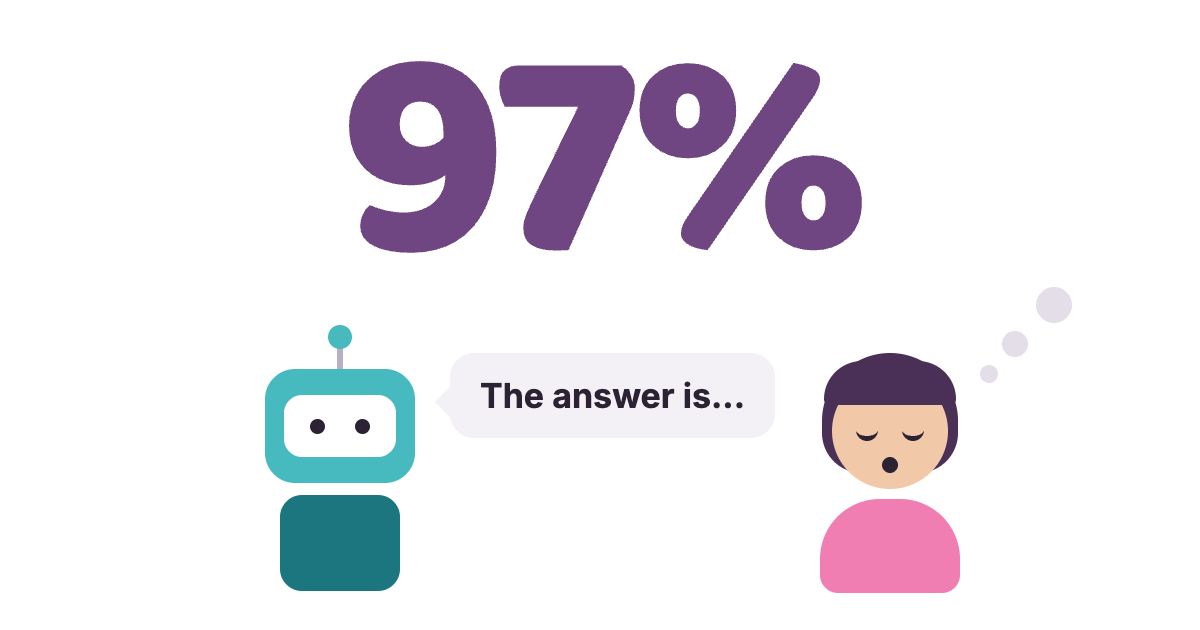
A development firm set up six frontier AI models to hold conversations with simulated students around 13 or 14 years old. The simulated students were designed to have the kind of misconceptions real students have in algebra. When the models were given generic instructions to be helpful, they gave away the answer in 97 percent of the conversations. It is worth being clear about what this was: a simulation, not a classroom study. It does not mean 97 percent of real lessons go wrong. What it shows is the default instinct of the technology. Left to its own devices, a model built to help will hand over the answer.
Told to be helpful, frontier models gave away the answer in 97 percent of simulated tutoring conversations.
A tutoring prompt helps. It does not fix it
When the same models were told to behave like a tutor, they did substantially better. But no model was consistently good at both of the things a tutor has to do at once: work out why the student is stuck, and hold back enough of the reasoning that the student still has to do the thinking. Other benchmarks say something similar. TutorBench tested 16 frontier models on whether they could adapt an explanation to a student's confusion, give useful feedback on their work, and offer a hint that kept the student active. The best one scored about 56 out of 100.
Why this matters more than it sounds
It is tempting to think a good prompt solves this. Just tell the model not to give away answers. But helpfulness is not a setting on top of these models. It is close to their core objective, reinforced over an enormous amount of training. A prompt asks the model to work against its own grain, and the research suggests it does so only partly and not reliably. A real tutor does something that runs the other way. It decides what the student needs next, asks rather than tells, and lets the student sit in the discomfort of not knowing yet. That discomfort is not a bug in the learning process. It is where the learning happens.
The big labs have noticed
OpenAI, Anthropic and Google have each introduced a learning or study mode designed to ask questions, scaffold steps and delay the answer. That is a meaningful shift, and a sign the industry takes the problem seriously. It is also worth remembering that a product's stated teaching approach is not the same as evidence that children learn more with it. A study mode is a promise about behaviour. Whether it holds up with a real ten-year-old on a Tuesday afternoon is a separate question.
What a learning tool has to do differently
Stanford's SCALE Initiative offers a useful working definition. An AI tutor pursues a defined learning objective, finds out what the student actually understands, adapts its next move, and keeps the student responsible for the thinking. Notice that being helpful is not on the list. Being useful to the student's learning is, and sometimes that means being deliberately unhelpful in the moment. So when you look at any AI tool for a child, the question is not whether it can explain things well. Almost all of them can. The question is whether it knows when not to.
Take these with you
- 1Told to be helpful, frontier models gave away the answer in 97 percent of simulated tutoring conversations.
- 2A tutoring prompt improved things, but no model reliably diagnosed confusion and held back the answer.
- 3The best of 16 models scored about 56 out of 100 on a tutoring benchmark.
- 4Helpfulness is close to the core of how these models are trained, not a setting you switch off.
- 5Ask of any learning tool: does it know when not to help?