
Year 3 · ages 7 to 8 · all subjects

Year 3 practice at home

Year 3 practice at home starts with knowing what your child learns this year. The times tables arrive, and so does telling the time to five minutes. In English, sentences grow longer and spelling gets trickier. Below you see it subject by subject.

Every subject has a free first lesson. Pick one and start today.

Age
7 to 8 years
Subjects
Seven subjects in one place
Try it
A free first lesson in every subject
01

What's new in Year 3?

Year 3 is the first year of key stage 2.

For many children it feels like a real step up. In maths, times tables become a big part of the week. Your child learns that 3 groups of 4 is the same as 3 times 4. Telling the time gets more precise, and the 24-hour clock appears. In English, your child writes longer sentences and checks their own spelling. Little and often works best.

02

What does your child learn in Year 3?

Maths

  • Adding and taking away within 100 in your head
  • Times tables as equal groups and arrays
  • Times tables from 2 to 9, starting with 2, 5 and 10
  • Finding the missing number in a times table fact
  • Telling the time to five minutes, and the 24-hour clock
  • Working out how long something takes
  • Choosing the right operation for a word problem

Spelling

  • Doubling a letter before -ed, like stopped
  • Words ending in -ly and -est
  • Compound words, like football
  • Spotting and fixing common spelling slips

Grammar and punctuation

  • Full sentences with a capital letter and a full stop
  • Spotting nouns, and names that need a capital letter
  • Question marks and exclamation marks
  • Putting spaces between words
03

How to help at home, ten minutes a day

10 min
  1. 1

    Practise one times table a week. Say it out loud on the way to school.

  2. 2

    Ask your child to read the time on a clock at home.

  3. 3

    Let your child explain how they worked it out. You will see where they get stuck.

04

How does your child practise Year 3 in BrainBite?

Each lesson takes a few minutes. A mentor explains every step at your child's pace. The explanation adapts to your child. As a parent, you see what goes well and what needs more practice.

05

Free worksheets for Year 3

Print a worksheet and practise together on paper. Each one has an answer sheet.

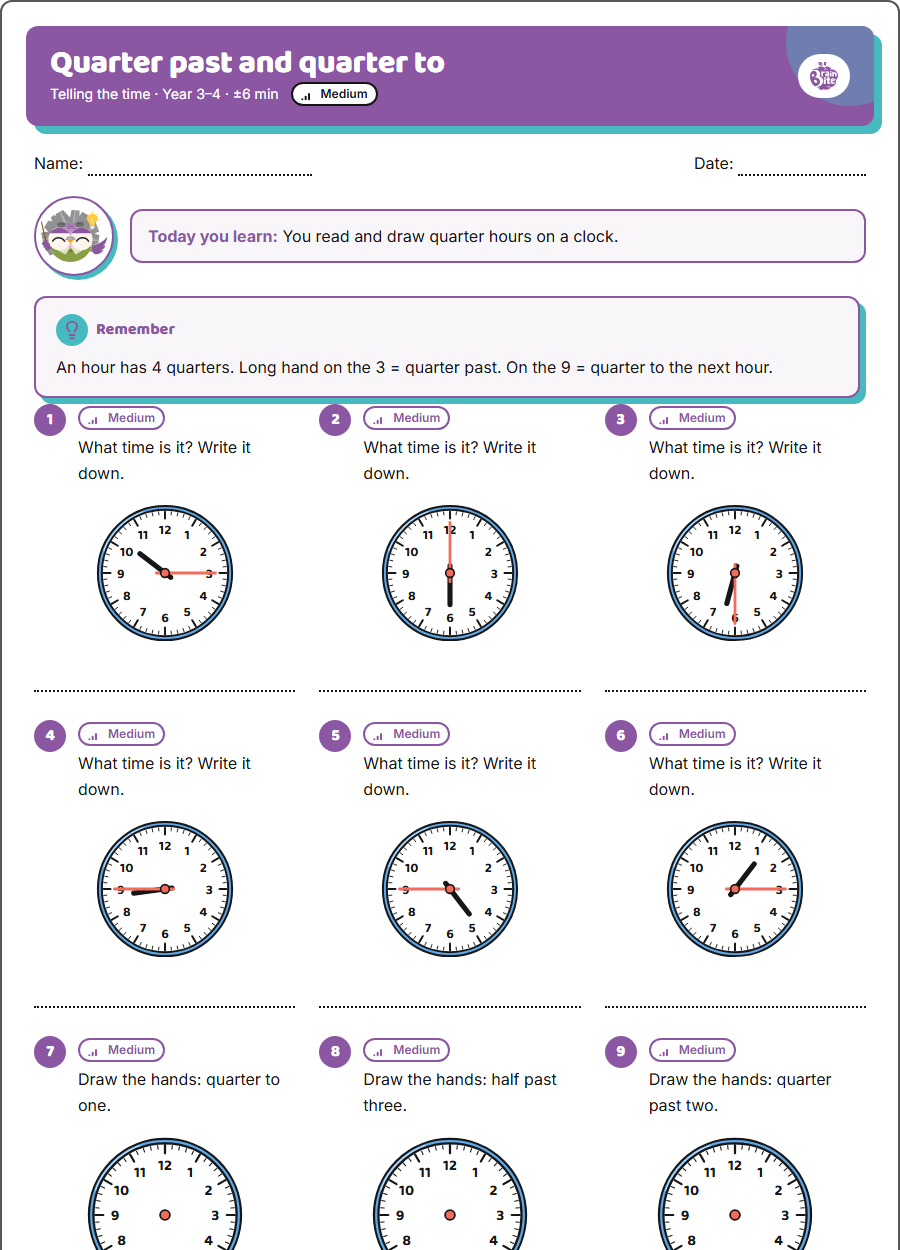
  • Preview of the worksheet Quarter past and quarter to
    MathsYears 3 and 4Telling the time

    Quarter past and quarter to

    You read and draw quarter past and quarter to on a clock.

    Download the worksheet

    PDF, with an answer sheet for you.

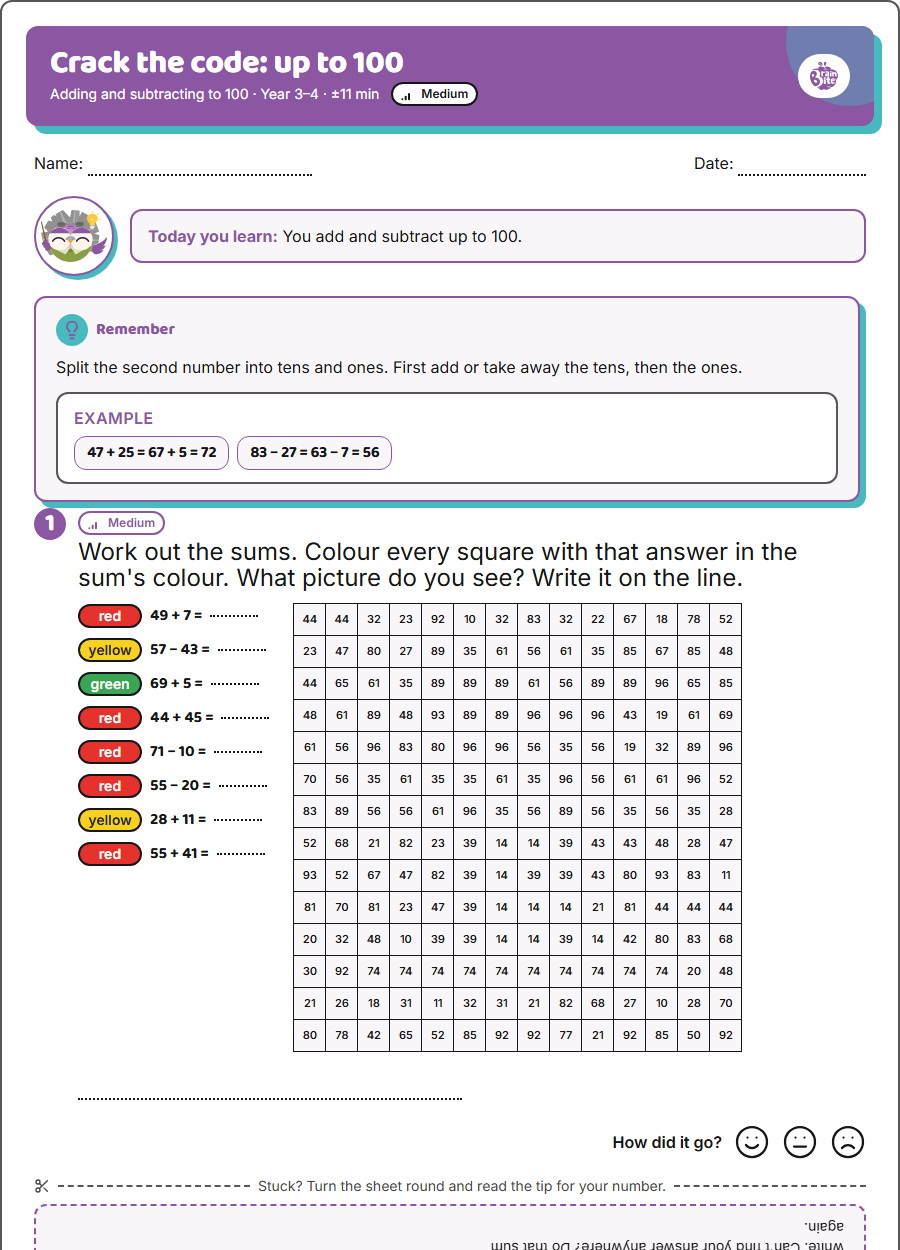
  • Preview of the worksheet Crack the code, up to 100
    MathsYears 3 and 4Crack the code

    Crack the code, up to 100

    You add and take away within 100.

    Download the worksheet

    PDF, with an answer sheet for you.

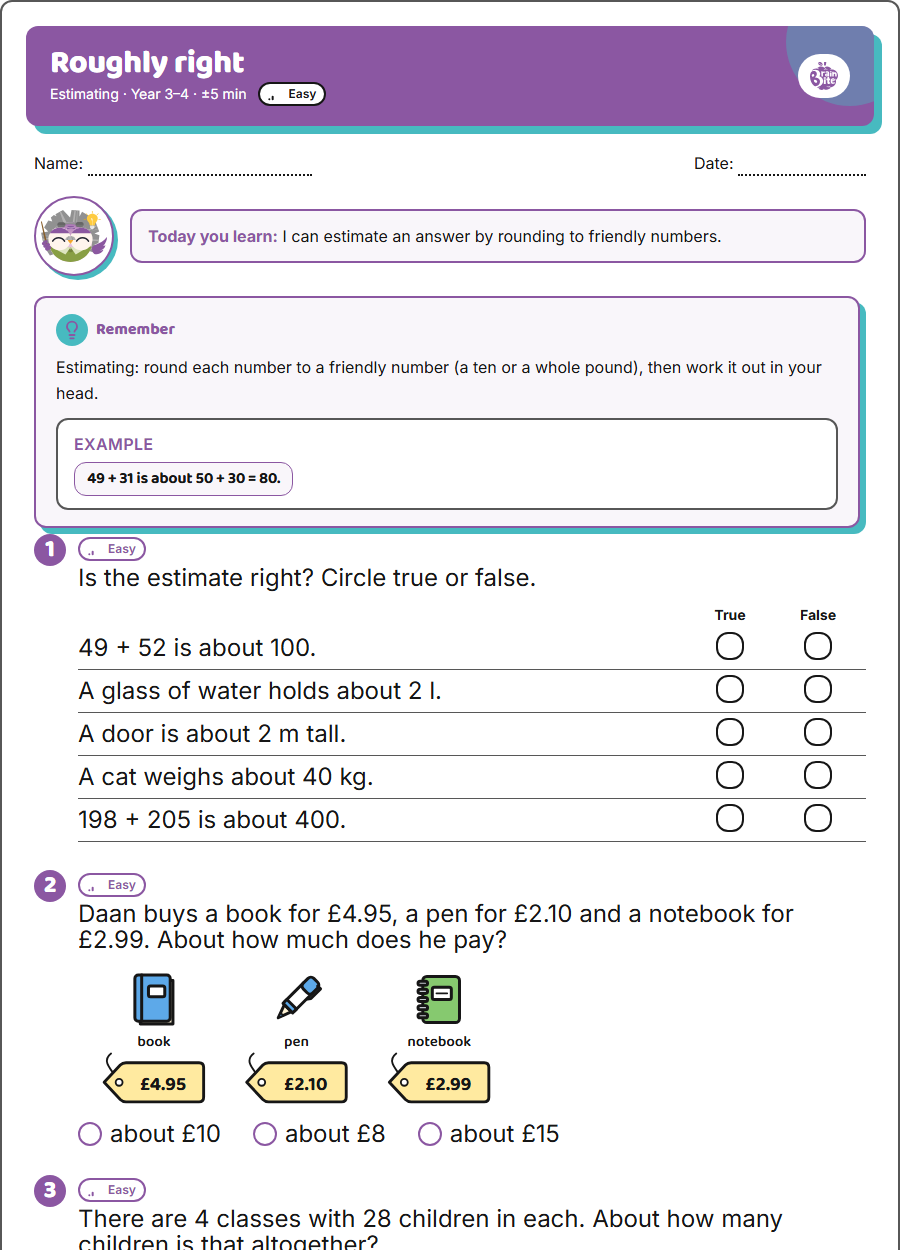
  • Preview of the worksheet Roughly right
    MathsYears 3 and 4True or false

    Roughly right

    You estimate an answer by rounding to friendly numbers.

    Download the worksheet

    PDF, with an answer sheet for you.

06

Which tests does your child take in Year 3?

There are no national tests in Year 3 in England. Your child's school may still use its own checks during the year. Ask the teacher how your child is getting on. The times tables check follows at the end of Year 4.

07

What comes in Year 4?

In Year 4 your child works towards knowing all the times tables quickly. Division and the first fractions come in too. In June, children take the multiplication tables check. Steady practice in Year 3 makes that much easier.

08

Questions from parents

In maths, adding within 100, the times tables and telling the time. In English, longer sentences and trickier spellings. And reading for the main idea of a story.

Every subject has a free first lesson. Pick one and start today.